

Moving a Grandfather Clock
16 Feb 2023
Request a Callback With Abels
Leave your details and one of our relocation experts will make it a priority to contact you and discuss your moving needs.
Quick quote
"*" indicates required fields
Our comprehensive guide to moving a grandfather clock or longcase clock
Abels Moving Services has decades of expertise in moving a grandfather clock and a wide range of other treasured timepieces. You might know yours as a grandfather clock, a longcase clock, a floor clock or a tall case clock. Either way, the same careful process applies. Our moving staff train at a dedicated school, where they practise assessing, dismantling, packing, unpacking and reassembling long case clocks, ensuring maximum care for your treasured heirloom.
Moving Home With a Longcase Clock
Moving home with a grandfather clock can feel daunting, because the case, the movement and the pendulum all need separate attention before the piece is ready for transit. The sections below walk through the whole moving process: how we assess, pack, transport and store your clock, and how to set up a grandfather clock after moving it.
If the clock is part of a wider move, our house removals team can move it with the rest of your home, with packing services for everything else and our concierge service to coordinate the whole move through one point of contact.
Moving a Grandfather Clock Step by Step
Here’s a quick grandfather clock step by step guide to what’s involved, before we walk through each stage in more detail below.
-
1.Inspect the grandfather clock for damage and report.
-
2.Wind up the weights, remove and mark left and right.
-
3.Remove the hood, wrap and place in a carton.
-
4.Remove the pendulum and fasten to the wooden spline.
-
5.Remove the clock workings, wrap in paper, package the keys and screws, label and place in the same carton.
-
6.Remove the clock case and pack on to the vehicle.
What to Know Before the Move
A grandfather clock is heavy, tall and full of delicate components, so it carries more risk than most furniture. Howard Miller, one of the best-known clock manufacturers, advises keeping a floor clock upright throughout a move, because laying it flat can put stress on the case and misalign the internal movement. In other words, a grandfather clock should never be moved horizontally. The pendulum should always come out first, since a swinging pendulum can cause permanent damage to the movement. Howard Miller and most clock specialists recommend professional movers for anything valuable, and professional help is the safest route for any clock you cannot afford to damage.
According to clock specialists Premier Clocks, a grandfather clock can weigh anywhere from 100 to 300 pounds, so moving the case is always at least a two-person job, and most movers use a proper dolly to take the strain. Two men working together can keep the case steady and upright on a staircase or through a doorway. Soft gloves are worth wearing wherever you touch the case or the movement, because the natural oils on skin can dull the finish. Emperor Clock Company notes that vibration in transit can damage the chime and striking mechanism, so secure the chime rods before a move, and measure doorways and staircases at both properties before moving day.
How to Move a Grandfather Clock Safely
If you are preparing a clock yourself, these points help you move a grandfather clock safely and protect the structural integrity of the case, once the pendulum, weights and hood are out:
-
Pad the case with moving blankets and secure them with packing tape, taking care that tape never touches the finish.
-
Wrap athe pendulum, weights and any fragile items such as finials separately, using packing paper or bubble wrap.
-
Check that the trunk door, the long door in the middle of the case, is closed and secure, and that any glass panels are protected.
-
Keep the case upright and make sure the clock has a clear route to the vehicle.
Our Grandfather Clock Removals Service
Assessment & Inspection
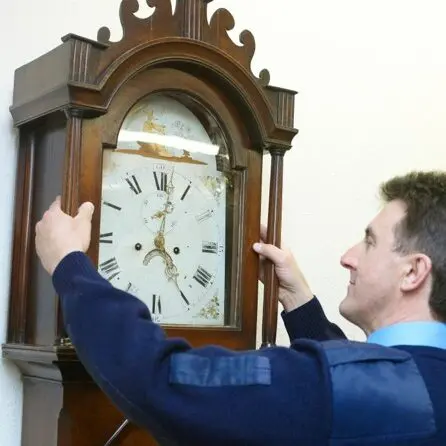
Before moving a grandfather clock, our first step is to inspect it together with the customer. We check for damage or any fragile, loose items, such as keys. Any damage to your antique clock is noted, photographed and reported to you.
Packing a Longcase Clock
The Abels removal teams carefully wind the weights up, normally to around three-quarters of the way up the case. They then unhook and mark them, left and right, ready for packing, so each weight goes back to its corresponding location on reassembly. Some longcase clocks have a third, centre weight for the chime, so Premier Clocks recommends marking it left, centre and right. The cord is then tightened with crushed paper.
The grandfather clock’s hood is removed and wrapped, then placed into a robust Abels carton with crush paper packed around it to restrict movement. Some movers use bubble wrap for extra cushioning, but Abels prefers close-packed paper, which holds the hood snugly in place without adding bulk.
Where a clock has a glass face or a glass door over the dial, we check it’s secure before packing, and Emperor Clock recommends taping an X across each glass pane to help prevent cracking. The greatest care is taken with the pendulum and clock workings, which are fragile and integral parts of the clock. We remove the pendulum, including the pendulum bob at its base, taking special precautions to avoid distorting the suspension spring at the top, known as the ‘feather’, and fasten it securely to a wooden spline. On chain-driven movements, the chains are secured too, so they can’t tangle.
The clock’s workings are then lifted from the base and placed in a carton, wrapped in white paper, taking care that the delicate hands aren’t damaged. We never use woollen blankets at this stage, because fluff can work its way into the movement and damage the workings. All keys and screws are bagged or parcelled, labelled and packed into the same carton.
We finally export wrap the clock case in fresh packing paper and secure it with packing tape, then stow it on our air ride pantechnicon. Emperor Clock also recommends wrapping the whole case in moving blankets for extra protection against scratches and knocks. Whether a clock travels in a specialist pantechnicon or a hired moving truck, it should stay upright and be secured so it cannot shift.
Grandfather Clock Movers: Our Trained Team
Our grandfather clock movers are trained in-house. Every member of our removals team has a high level of security clearance and carries identification at all times, and the packing techniques of our staff are honed each year in our training school.
Transporting Other Timepieces
The same skills apply whether the timepiece is a mantle clock, hooded wall clock, carriage clock, Vienna clock or grandmother clock. Abels can handle your antique timepieces alongside other antiques and furniture in the same move, so there’s no need to book a separate specialist for each piece. Our piano moving team uses a similar level of specialist care, because a piano shares many of the same handling challenges as a grandfather clock: both are heavy, awkward in shape and built around delicate internal parts. If you are also moving a chandelier, read our guide to that as well.
Casing Clocks
Clocks of high or sentimental value can have a custom wooden case made for them, essentially a fitted box built around the exact shape of the piece. The case is lined with foam, with foam blocks to stop the clock shifting during transit, and it can be held in Abels’ store until the next time the clock is to be relocated.
Storing Your Clock Until You’re Ready
If your new home isn’t quite ready, Abels can store your grandfather clock in facilities with state-of-the-art Redcare linked alarm systems, monitored by CCTV. Warehousing is modern, clean and dry. Your clock stays in the case it was packed in, marked with your name, reference number and destination, so it can be found easily whenever you’re ready for it.
Clock Repair & Cleaning Service
A big move is a natural moment to have your grandfather clock cleaned and restored while it is already dismantled. Our experts take the clock apart to clean it, avoiding solvents that could cause damage or leave a film that attracts dust. This can be carried out at your home or at our partner’s workshops. Damaged wooden cases can be restored, and broken clocks can be returned to working order.
How to Set Up a Grandfather Clock After Moving It
Setting up your grandfather clock in its new location is no more involved than packing it for the move. In general, you reassemble the clock in reverse order to how it was packed: case first, then the movement, hood, weights and finally the pendulum. Take it slowly, because a rushed setup is a common reason a clock keeps poor time after a move. Follow this quick pendulum guide once your clock is back in place.
-
Ensure your clock stands on a level surface, since this keeps the time-keeping mechanism working correctly.
-
Give your clock time to settle in its new location. The pendulum needs time to return to its regular swinging pattern before you set it going again.
-
Set the correct time by moving the minute hand forwards slowly, letting the clock chime at each quarter hour, hour and half hour as you pass it. If you’re unsure, check the manufacturer’s instructions for your clock.
-
Wind the clock as often as its movement needs, which is commonly once a week. Regular winding keeps it in working order and keeps the correct time.
Why choose Abels for grandfather clock removals
Abels’ own cover for your move is called MoveProtect. Abels is a member of the British Association of Removers (BAR member A001). We hold ISO 9001, ISO 14001, ISO 45001 and ISO 27001 certification, which together cover quality, environmental, health and safety, and information security management. Abels also holds a Royal Warrant as Removals and Storage Contractor by Appointment to His Majesty The King, first granted in 1988 and re-granted in January 2025. These credentials sit alongside the specialist skills every grandfather or longcase clock needs, from the first inspection through to setting it going again in your new home.
For a clock that’s also a fine art or antique piece, our fine art and antiques removals team can advise on handling and climate-controlled storage where it is needed. You can read verified customer reviews of our service, or request a quote to discuss moving a grandfather clock.
FAQs
Do you need a specialist to move one?
How much does it cost to have a clock moved?
Can you lay a grandfather clock down to move it?
Can I move the hands backwards on a grandfather clock?
Why has my grandfather clock stopped after a move?
Can I move a grandfather clock myself?
How do I get rid of an old longcase clock?
How much is a 100 year old grandfather clock worth?
Does Abels offer grandfather clock removals?
Abels Moving Services:
 +44 1842 816600
Start Your Move with Abels
Your Move Matters, help us understand your requirements and we will be in touch as soon as possible